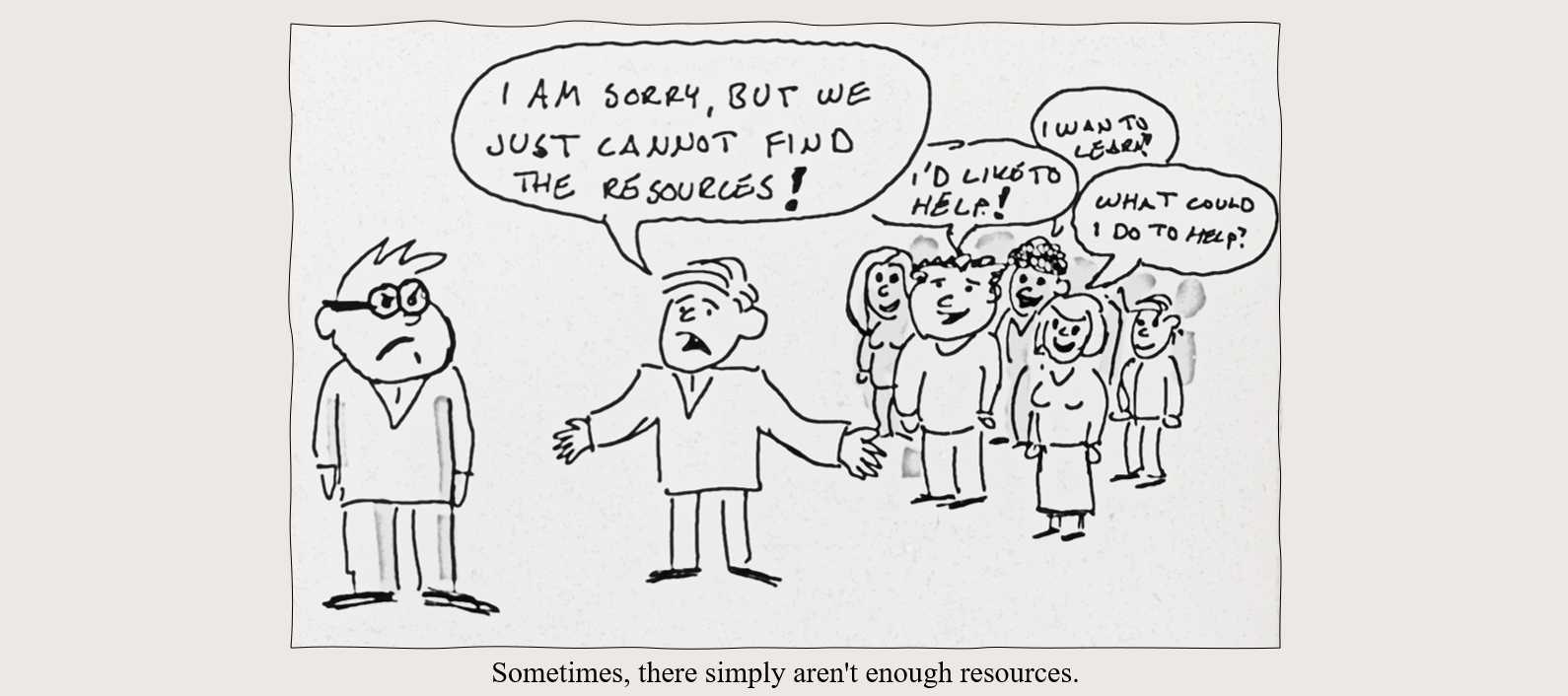
In IT, there is always a shortage of developers — whether the cause is tight budgets or a lack of skilled experts. Citizen development is frequently offered as the solution. But is it truly worth the investment? Are there better alternatives? And if you do pursue it, how do you measure what you actually get back?
This article discusses approaches to enabling citizen development and the real-world challenges these initiatives face. Three alternative approaches are proposed that might produce better results if citizen development is not the right fit for your organisation — along with ways to understand the return on investment. The focus is mainly on low-code as an example, but the insights apply to citizen development in other areas such as Business Intelligence and Analytics.
The Rise of the Citizen Developer
The search for a solution to make app creation easier for non-programmers has existed ever since the invention of the computer. BASIC was invented in the 1960s to allow students in non-scientific fields to use computers and write apps. COBOL — Common Business-Oriented Language — was designed in 1959, 65 years ago, with English-like syntax deliberately chosen to make it readable to business people. Visual Basic later allowed developers to draw the UI and attach code to interface elements.
Today, low-code tooling can be seen as the continuation of this long-running search for easier app creation. What current low-code platforms have brought with them is an efficient, managed distribution mechanism; portfolio management for assessing the value of initiatives; integrated user experience measurement; collaborative project spaces; agile project management; and AI-assisted development tools.
The Logic Behind Citizen Development
The case for citizen development rests on three assumptions:
- The person working in the business team knows best the problems they face and has the best ideas on how to use technology to fix them.
- Enabling that person to create the apps that solve their own problems provides a quicker turnaround in the iterative cycle of develop–test–deploy.
- Introducing even a basic level of development competency to a large number of employees can, together with the right tools, significantly reduce the need for professional developers.
This logic is sound in general. If a person has a problem and the means to fix it, they usually do a good job. And output increases with numbers. Citizen development effectively shortens the feedback loop between development, testing, and deployment to an absolute minimum — in the best cases, the entire loop takes place inside a single person's head.
Providing the Best Means Possible
Training a person to use a tool immediately unlocks new options for solving day-to-day problems. In fact, as you read this, someone in your organisation is probably learning a tool on their own time or tinkering with something that could end up being critical for their team.
The best results from citizen developers come when they are given training and frameworks that allow them to use tooling like low-code in the best and most secure way possible. If the platform provides guardrails that guide the citizen developer, results will be even better.
A simple starting point is internal marketing — making everyone aware of the tooling and training that is available. Most low-code platforms today have Online Academies where training is free beyond the time it takes to complete. Pointing business teams toward this training can be the push those who are interested need to get started.
Hackathons have also worked well for many organisations — giving volunteers quick training, building simple use cases together, and letting participants experience the satisfaction of completing something useful. Focused workshops with individual teams — "Let's fix a problem with low-code" — can be even more targeted: identify what low-code handles well, build a solution together, and take it through review and deployment as a team.
Nurturing the Emerging Talent
Not everyone who starts will continue. That is natural. But some will love it and keep finding new ways to apply the tooling. Those individuals need ongoing support to develop further.
Mentorship models work well here. A more experienced developer collaborates with the citizen developer, sharing best practices, organisational-specific approaches, and security and privacy considerations that are not covered in any training course.
Regular community meetings keep people engaged — though their longevity depends on the community itself. If the group is active and willing to share learnings, the meetings thrive. If not, they fade.
The outcome is a developer who combines deep business knowledge with real technical capability — a combination that is rare, valuable, and impossible to hire from outside.
Marketplaces of pre-made components, frameworks, and reusable assets reduce the effort required for individual citizen developers. Enabling them to contribute their own components builds community and incentivises continued learning. Celebrating achievements — recognition from management, even financial rewards — can have a significant effect on sustained participation.
Providing Direction
Without direction, citizen developers will naturally gravitate toward use cases that matter to their immediate team — which is not always where the organisation most needs them. A planned system decommission, for example, can render citizen developer work worthless if they were not aware of it.
Direction can also harness the collective power of citizen developers to address organisation-wide problems. One compelling example: a company with over 50,000 suppliers, each with unique portals, needed to automate data collection at scale. Rather than using full-time developers, they created a framework that divisional developers could use to automate their specific portals. The result: a significant productivity boost, much shorter development time, and broad coverage that a central team could never have achieved alone.
Leading low-code platforms provide portfolio management features specifically to support this kind of directional alignment — ensuring projects citizen developers undertake are connected to business goals, not just team preferences.
Some Challenges with Citizen Development
Building and sustaining a citizen developer community takes time and effort — typically from IT or a Centre of Excellence that has other priorities. The capacity cost is real and is often underestimated.
Apps citizen developers create may need maintenance that the citizen developer cannot provide. Anything deployed to production requires review for security, safety, and compliance. This review burden on IT or the Centre of Excellence can become overwhelming — leading to either degraded apps or long deployment delays that frustrate the very people who built them.
In some organisations, the jump from simple use cases to more valuable ones is too great. Technical, privacy, or security requirements become overwhelming, and the effort required to learn everything becomes off-putting.
Citizen developers may also be pulled back to their primary roles when priorities change or when their team is under pressure. Development time becomes sporadic. A promising journey stops — and everyone involved feels they have wasted their time.
Licensing cost is another constraint. Depending on the platform's licensing model, it may simply not be viable to train a large number of people if many of them will only use the license intermittently.
Alternatives to Citizen Development
Three alternatives are worth serious consideration before committing to a citizen development programme.
The Key Developer Approach
Rather than training everyone, select a smaller group of identified individuals in the business organisation. To be included, employees complete training and a test that demonstrates a certain level of competency. This approach tends to surface people who are already self-motivated — those who have started learning on their own time. These individuals are a natural fit for the Key Developer role and are far more likely to sustain their development capability long-term.
Career Transition to Full-Time Developer
A more ambitious alternative: identify employees in business roles who show strong aptitude and genuine interest, and create a structured path for them to transition into full-time developer roles. This is not a part-time citizen developer arrangement — it is a career-changing decision made by the employee and their manager, with serious commitment on both sides. The outcome is a developer who combines deep business knowledge with real technical capability, which is a rare and valuable combination.
Invest in IT Capacity Directly
The third alternative is to invest the time, money, and effort that a citizen development programme would require in building IT's own development competency instead. The number of apps developed will likely be lower — but whatever gets built will address the highest-priority problems and do so with high quality. With a low-code platform supporting the IT team, development time is significantly shorter than it would otherwise be.
Understanding Return on Investment
A citizen development programme can be a significant investment, and it deserves a rigorous ROI framework — not just a count of apps delivered.
Every use case should have a clear set of success criteria and a benefit/effort analysis before implementation. The key business questions are: how will this use case impact growth, revenue, and profit? Those questions should be asked about every individual use case, not just the programme as a whole.
Summing It All Up
A citizen developer programme can lead to transformative results: unleashed creativity, boosted productivity, reduced IT backlogs. It can also be volatile — leading to disappointments and wasted effort for everyone involved.
Before starting such a journey, analyse honestly whether "everyone building apps" is truly one of the things that will significantly move your organisation toward its goals, compared to all the other initiatives competing for the same budget and attention.
Consider also whether citizen development will become a genuine part of the organisation's core — and whether the organisation is able to maintain the required commitment even through changes in leadership or organisational structure.
If the answer is no, a different investment will likely serve you better.
If the answer is yes, you could be starting something genuinely exciting.
Turn Insights Into Action
Talk to our team about the right approach to low-code, citizen development, or IT capacity for your organisation.
Get in Touch →