Your AI Agents
Are Live.
Do You Have Clarity On Their True Impact?
Most organisations deploying AI agents have no meaningful visibility into their performance. iwow's QPR Process Intelligence-powered observability dashboard provides total transparency — from token consumption to real, quantified process improvement.
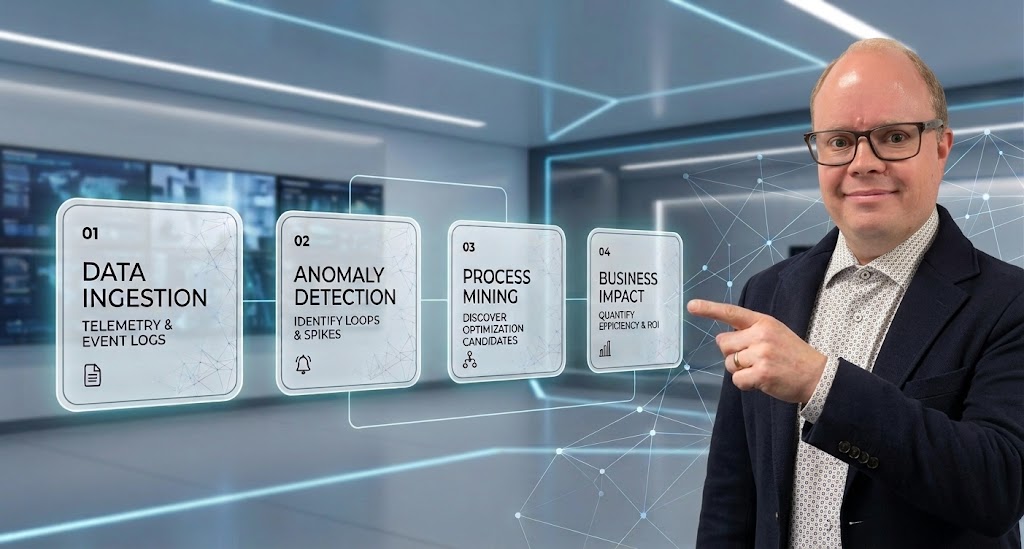
Flying Blind on
AI Agent Performance
Organisations are deploying AI agents at speed. But most have no way to answer the questions that actually matter.

Your agents are running — but what decisions are they making? What paths are they taking? What actually happens when something goes wrong? Without observability, these questions have no answers.

With no consumption tracking, token costs scale with usage — but not necessarily with value. Inefficient agents silently inflate infrastructure spend before anyone notices the pattern.

Agents can fall into repetitive cycles — re-validating the same data, retrying failed calls, or looping through the same decision branch. Each cycle wastes tokens and delays outcomes, invisibly.

Proving that AI agents have made operations more efficient is nearly impossible without baseline measurements and continuous tracking. The ROI stays invisible — to leadership and to you.
Unsupervised AI Agents Are a
New Attack Surface
Agents operate with broad access to data, APIs, and external services. Without observability, a compromised or manipulated agent can cause serious damage long before anyone notices.
Malicious instructions embedded in documents, emails, or web pages the agent processes can override its original directives — causing it to execute attacker-controlled commands as if they came from a trusted source. The agent follows the injected instruction without raising any error.
Through carefully crafted inputs or gradual drift in multi-step reasoning chains, an agent can be steered toward objectives that diverge significantly from its design. There is no crash, no alert — just an agent doing the wrong thing with full authorisation.
Agents with broad data access can be coerced into summarising, copying, or transmitting data they were never meant to touch — customer records, credentials, internal strategy documents. The access is legitimate; only the intent is not.
Agents making calls to external services, triggering automated workflows, or exercising permissions outside their intended scope can cause downstream damage — financial, operational, or reputational — that is difficult and sometimes impossible to reverse.
When an agent goes off-script — whether through a prompt injection attack, goal drift, or unintended tool use — the QPR process map in the iwow AI Agent Dashboard surfaces the deviation immediately. Execution paths that diverge from baseline, unexpected API calls, token consumption spikes consistent with context-stuffing attacks, and anomalous data access patterns all become visible in real time. The faster you see it, the faster you can act. Without observability, you are relying on downstream damage to tell you something went wrong.
Seeing is believing.
Join the waiting list and we'll show you what your AI agents are actually doing — in your own environment, with your own data.
Complete Visibility Into Your AI Agents
and the Processes They Run
Four integrated layers of intelligence — from individual agent telemetry to organisation-wide process analytics.
Agent Telemetry &
Token Analytics
Know exactly what your agents are doing and what it costs.
Real-time tracking of every agent action, token consumption, decision path, and execution chain. Surface anomalies — cost spikes, unusual paths, slow completions — as they happen rather than after the damage is done.
Loop Detection &
Anomaly Surfacing
Stop runaway agents before the cost compounds.
QPR Process Intelligence automatically detects when an agent is caught in a repetitive cycle or exhibiting anomalous behaviour. Alerts fire in real time so your team can investigate and intervene before the pattern scales.
Pattern Mining &
Automation Candidates
Turn repeated agent behaviour into permanent, lower-cost automation.
When an agent consistently follows the same execution path, the QPR engine flags it as a candidate for rule-based automation — so your organisation captures lasting value from AI behaviour rather than simply consuming it.
Process Impact
Analytics
Prove the business case with numbers that hold up to scrutiny.
Baseline your processes before deployment, then track efficiency improvements continuously. Quantify exactly how much faster, cheaper, or more consistent operations have become since AI agents were introduced.
Query your agent dashboard
in plain language
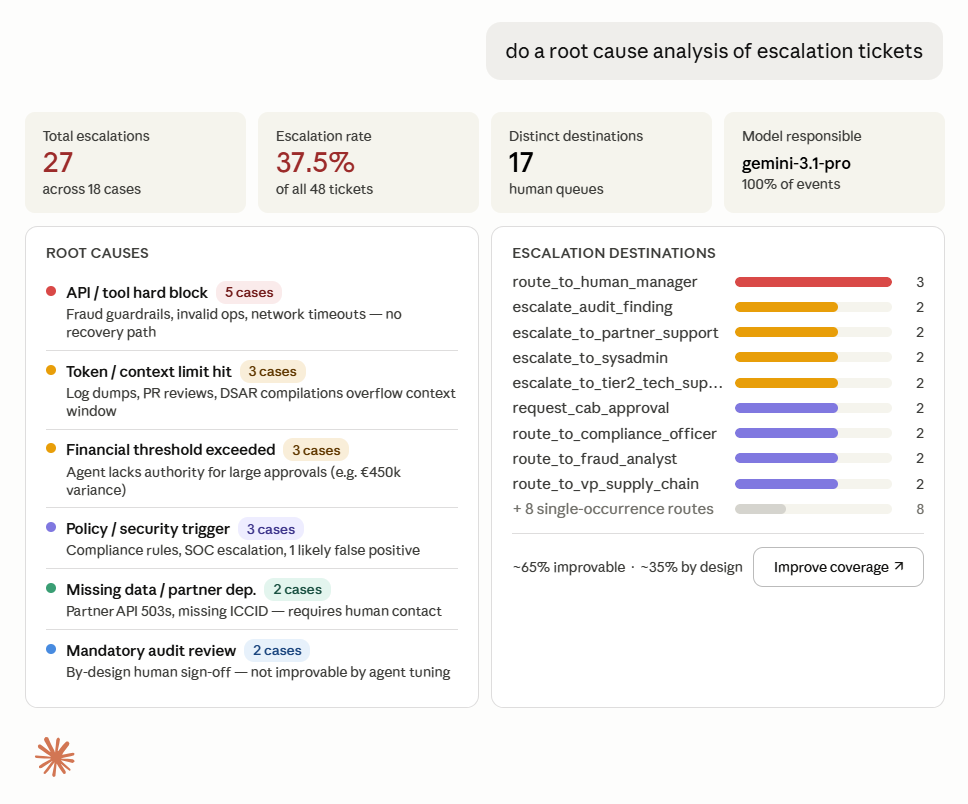
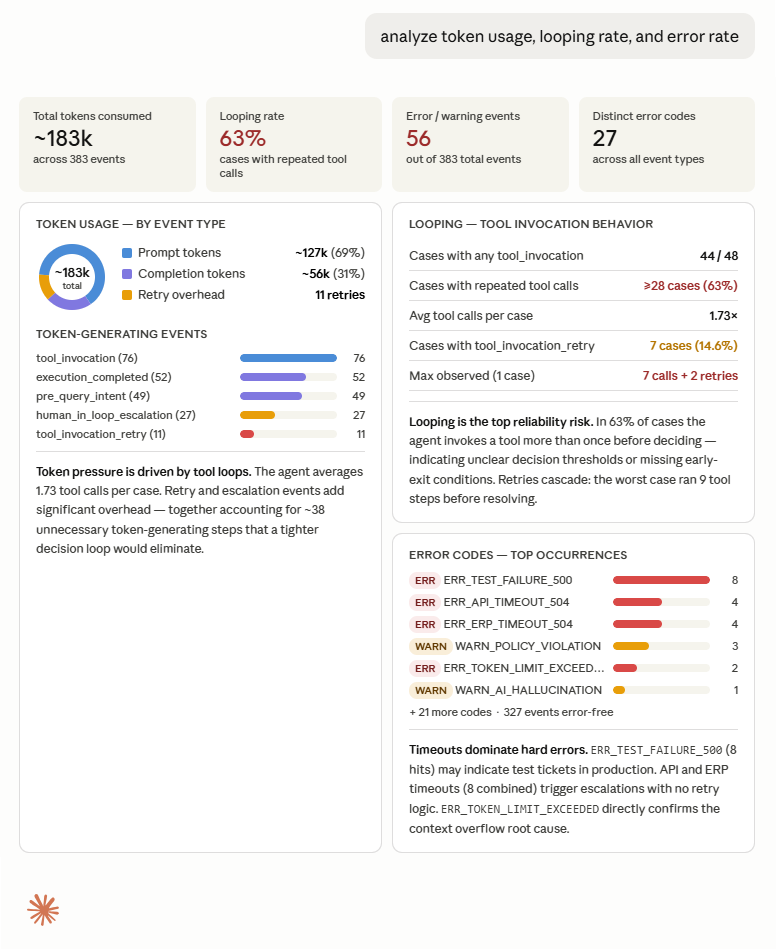
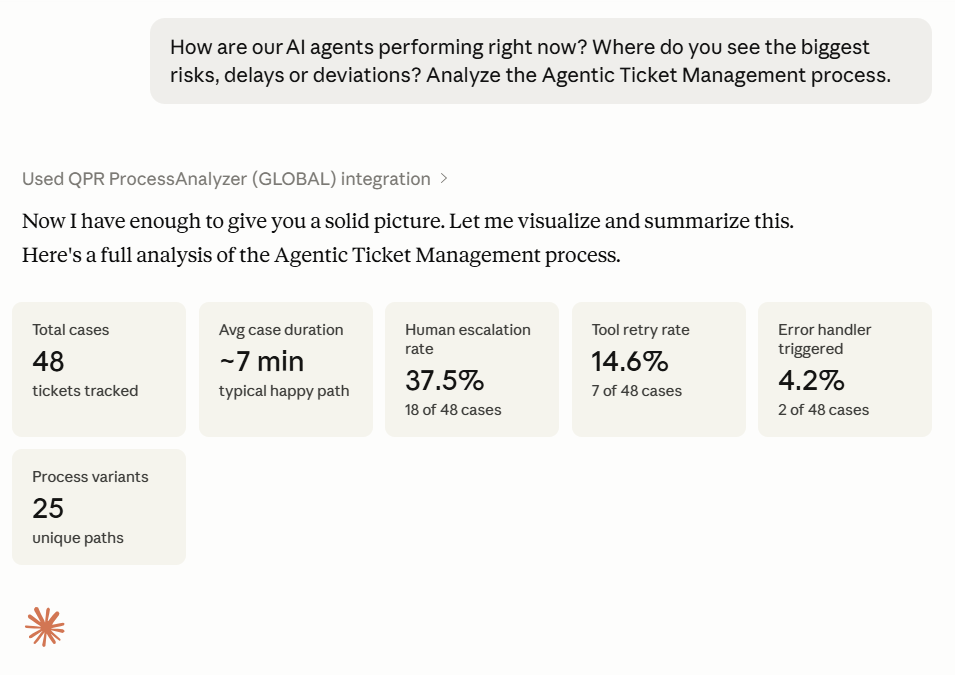
The iwow AI Observability dashboard exposes its data through QPR's MCP server. Ask an AI agent what your agents are doing — and get structured answers from the dashboard directly in your workflow.
Up and Running in Days,
Not Months
A lean onboarding process designed for enterprise AI environments — minimal disruption, fast time to insight.
We integrate the observability layer with your existing agentic infrastructure. Supports all major agent frameworks and orchestration platforms, on-premise or cloud.
QPR Process Intelligence ingests agent event logs and reconstructs actual execution behaviour against your process models — automatically, continuously, and without manual tagging.
The dashboard surfaces loop detections, anomaly alerts, pattern candidates, and token analytics — in a single view anchored to your real process context and organisational data.
Track process-level efficiency gains over time. Generate clear, quantified reports of improvement that leadership can act on and stakeholders across the business can trust.
Connect AI Performance
to Business Outcomes
Tracking individual agents is only half the picture. The iwow observability dashboard connects agent activity to your broader organisational metrics — so you can see exactly how AI deployment is moving the needle on the processes that matter most.
-
Link agent KPIs directly to end-to-end process metrics — cycle time, error rate, throughput
-
Set baselines before deployment so efficiency gains are rigorously measured, not estimated
-
Track multiple AI initiatives in parallel with a unified view across processes and departments
-
Generate board-ready ROI reports backed by process data — not assumptions or self-reported estimates
Illustrative data based on enterprise AI deployments tracked through QPR Process Intelligence.
Built on QPR Process Intelligence
iwow's observability dashboard runs on QPR — the enterprise-grade process mining platform trusted by global organisations for deep, data-driven process visibility.

QPR Process Intelligence delivers insight into how processes actually behave — reconstructing real execution paths from event logs rather than relying on assumed process models. As a certified QPR partner, iwow combines QPR's process mining engine with purpose-built AI agent telemetry to give your organisation the visibility that generic monitoring and logging tools simply cannot provide.
QPR is used by enterprises across Europe and globally in finance, insurance, public sector, and manufacturing. iwow has deployed QPR in production settings including a process mining proof-of-value at Consilium Safety Group, analysing 190,000 order cases to surface optimisation opportunities invisible to manual review.
Recognised by Gartner. QPR has been named a Visionary in the 2026 Gartner Magic Quadrant for Process Intelligence Platforms — for the fourth consecutive year. An independent validation of the platform's capability and strategic direction.
Built for the agentic era. The observability data model is accessible directly through QPR's MCP server, allowing AI agents and orchestration platforms to query live process intelligence data natively — closing the loop between your agents and the processes they run.
Bring Your AI Agents Into Focus
We're onboarding a limited number of early access organisations. Join the waiting list and be first in line when we open up.
Join the Waiting List →Frequently Asked Questions
Which AI platforms and agent frameworks does the observability layer support?
The observability layer works with any agent infrastructure that produces structured event logs — including LangChain, AutoGen, CrewAI, Microsoft Autogen, and custom-built agentic pipelines. We configure the integration during onboarding to match your specific setup.
How does QPR Process Intelligence differ from standard application logging?
Standard logging captures what happened. QPR Process Intelligence maps how it happened — reconstructing complete execution paths, identifying process variants, comparing them against expected models, and surfacing patterns across thousands of cases. It turns raw event logs into a living map of how your agents and processes actually behave.
How quickly can we see value after deployment?
Most organisations see actionable insights within the first week. Loop detections and anomaly alerts surface immediately once agent logs are flowing. Pattern candidates accumulate after a few days of operation. Baseline comparisons require a pre-deployment data capture, which we set up as part of onboarding.
What does "loop detection" mean in practice?
A loop is when an agent repeatedly executes the same sequence of steps without progress — for example, retrying the same validation, re-querying the same tool, or cycling through the same decision branch. QPR detects these as variant patterns in the process map and raises an alert so your team can investigate the underlying cause before costs compound.
Can the dashboard identify automation candidates automatically?
Yes. When an agent consistently follows the same execution path for a class of inputs, QPR flags it as a candidate for rule-based automation. Candidates are surfaced in the dashboard with frequency and confidence data — so your team can prioritise which patterns to convert into deterministic, lower-cost automations.
How does this connect to our existing BI and reporting tools?
QPR supports standard data exports and API integrations, so dashboard metrics can feed into existing BI environments including Power BI, Tableau, and others. We help configure the data flow during onboarding to ensure observability metrics surface in whichever reporting layer your organisation already relies on.
Join the Waiting List
We're onboarding a limited number of early access organisations. Drop us a line and we'll be in touch to discuss your environment and timeline.